Introduction
[1] The applicant seeks an order that there is a manifest inaccuracy in the Land Register in respect of part of premises at 2 Kirk Lodge, Pitlochry, PH16 5JL (the “Disputed Room”). Numbers 1 and 2 Kirk Lodge form two dwelling houses within a larger building which was originally a church, then a large house, subsequently divided. The building now comprises a terrace of three separate dwellings, with addresses 1, 2 and 3 Kirk Lodge.
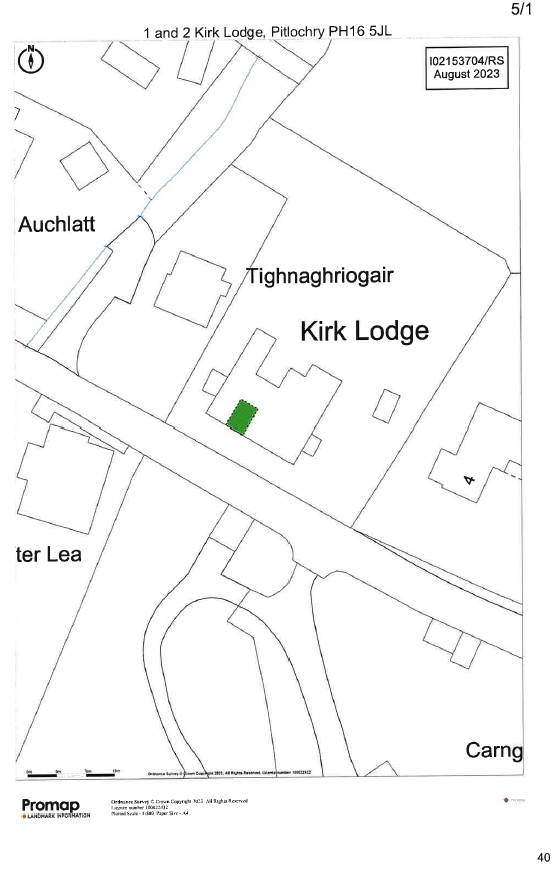
[2] The Disputed Room comprises a first floor room which forms part of the interested party’s registered title to 2 Kirk Lodge but part of the occupied extent of the applicant’s property. The Disputed Room is shown shaded green on the plan provided as a production by the applicant, reproduced as “Annex 1” hereto.
[3] Titles to each of 1 Kirk Lodge and 2 Kirk Lodge are now both registered, but the applicant’s registered title excludes the Disputed Room. The applicant’s position is that the Land Register should be rectified by removing the Disputed Room from Title Number PTH59517 (the interested party’s title) and by incorporating the Disputed Room as part of Title Number PTH3637 (the applicant’s title).
[4] The application was opposed by the interested party contending that the Disputed Room forms part of the title to 2 Kirk Lodge as first conveyed in 1960 and does not form part of the title to 1 Kirk Lodge as first conveyed in 1966.
Procedure
[5] At a diet of proof before answer at George House, Edinburgh on 6 August 2024 the applicant was represented by Mr Andrew Upton, solicitor, of Harper Macleod LLP. The interested party was represented by Mr Alistair Murdoch of Murnin McCluskey, Solicitors. The applicant adduced two witnesses, namely the applicant himself and Mrs Julia Seiffert, the previous heritable proprietor of 1 Kirk Lodge before the applicant. The interested party gave evidence.
[6] The Keeper did not enter proceedings but instead provided a letter explaining that no manifest inaccuracies have been demonstrated to her in relation to the properties in question and that these are accordingly matters for the Tribunal to determine.
[7] On 1 August 2024, in advance of the proof diet, the Tribunal members visited Kirk Lodge (accessing both 1 and 2 Kirk Lodge) to familiarise themselves with the Disputed Room. Following the hearing the parties were given a further period of two weeks in order to set out their final written statements for consideration by the Tribunal.
Productions
[8] The applicant lodged various productions including copy title deeds, copy valuation roll and census entries relative to the properties at Kirk Lodge and correspondence between solicitors acting for Mrs Seiffert and the solicitors acting for Mrs Pirnie during Mrs Seiffert’s ownership of 1 Kirk Lodge. The respondents lodged copies of correspondence with the Keeper. The Keeper lodged various productions including copies of the application for first registration of the subjects comprising 2 and 3 Kirk Lodge in 2000 and the application for first registration of 1 Kirk Lodge in 2021. We do not set out the detail of each of these productions but have referred further to these in our decision below.
The applicant’s title – 1 Kirk Lodge
[9] The applicant’s title to 1 Kirk Lodge was registered on 3 March 2021. The applicant’s title comprises the subjects shown tinted pink on the Title Plan to PTH59517 and includes:
“a right in common with the proprietor of the subjects adjoining on the South-east to the mutual access and yard tinted blue on the cadastral map.”
1966 Disposition
[10] The applicant’s title derives from subjects originally conveyed by Disposition by the Trustees of Christina Dow and others in favour of John Louis Gerard and Anne Gerard dated 24 December 1965 and recorded in the Division of the General Register of Sasines applicable to the County of Perth on 10 March 1966 (the “1966 Disposition”).
[11] The description of the subjects conveyed in the 1966 Disposition is as follows:
“ALL and WHOLE that dwellinghouse on the First and Second floors at Kirk Lodge, By Pitlochry in the Parish of Moulin and County of Perth all as presently occupied by our said disponees and erected on the area of ground (SECOND) hereinafter disponed;”
[12] The said subjects (SECOND) conveyed are described as:
“ALL and WHOLE that area or piece of ground in the said Parish and County lying to the North‑east of the public road leading from Pitlochry to Kirkmichael extending to One Hundred and Fifty‑one decimal or one‑thousandth parts of an acre or thereby Imperial Measure and bounded as follows:– On the South‑west by the said public road along which it extends a distance of Thirty‑three feet four inches or thereby; On the North-west and again on the South‑west by the centre line of a mutual dyke and fences separating the said area of ground from ground belonging to Ian Farquharson Malloch along which it extends distances of One Hundred and Forty‑nine feet four inches or thereby and Thirty‑nine Feet Eight inches or thereby respectively; On the North‑west and North‑east by land belonging to Balnakeilly Estate along which it extends distances of Nineteen feet or thereby and Seventy‑seven feet or thereby respectively; Generally on the East and South‑east by subjects belonging to Alexander Pirnie the boundary of which commencing at the most north‑easterly point runs in a south-westerly direction along the centre line of a mutual fence for a distance of Seventy‑seven feet ten inches or thereby; Then along the edge of the mutual yard aftermentioned (first) in a westerly direction for a distance of Twenty‑one feet three inches then in a south‑south-westerly direction for a distance of Nine feet or thereby then in a south‑easterly direction a distance of Fifteen feet seven inches or thereby then in a south‑south‑westerly direction for a distance of Twenty‑six feet five inches and then in a south‑easterly direction for a distance of one foot nine inches or thereby and thereafter the boundary runs in a south-south‑westerly direction along the mutual gable separating the subjects (FIRST) Hereinbefore disponed from subjects belonging to Alexander Pirnie and then in a direct line to the said public road for a distance of Forty‑six feet two inches or thereby; ALL as the said area or piece of ground is delineated and coloured pink on the plan annexed and signed as relative hereto;”
[13] The subjects are conveyed together with:
“(One) The whole building and erections on the said subjects (SECOND) hereinbefore disponed; (Two) The fitting and fixtures pertaining to the whole subjects hereby disponed so far as belonging to us (Three) A right in common along with the said Alexander Pirnie as proprietor of the subjects adjoining on the South‑east and his successors and assignees to the mutual access from the said public road and to the yard lying to the north‑east of the subjects (FIRST) hereinbefore disponed all as the said access and yard is delineated and coloured brown on the said plan or sketch; (Four) a right in common along with the said Alexander Pirnie and his foresaids as proprietors foresaid so far as we can grant the same to (a) the solum upon which the said subjects (FIRST) hereinbefore disponed are erected so far as not erected on the said subjects (SECOND) hereinbefore disponed; … (d) to all mutual gables, chimney heads, rhones, down pipes, gutters, drains, pipes, electricity lines and others with right of access thereto for all necessary maintenance, repair or renewal; (Five) The parts pertinents and privileges thereof and (Six) Our whole respective right, title and interest both present and future as Trustees foresaid in and to the said subjects; …”
1989 Disposition
[14] The subjects were conveyed on to Mrs Seiffert by Disposition by Mrs Annie Gerard and the Executrix of the late John Louis Gerard in favour of Julia Logan (thereafter Seiffert) dated 18 September and recorded in the General Register of Sasines on 11 October both months 1989 (the “1989 Disposition”). In the 1989 Disposition the subjects were described by reference to the 1966 Disposition, viz:
“ALL and WHOLE that area or piece of ground in the Parish of Moulin and County of Perth together with the dwellinghouse on the first and second floors at Kirk Lodge and the whole other buildings erected thereon being the subjects more particularly described in disponed by and shown delineated and coloured pink on the plan annexed and signed as relative to [the 1966 Disposition]”.
2021 Disposition
[15] 1 Kirk Lodge was conveyed to the applicant by Disposition by Julia Seiffert dated 26 February 2021 and registered in the Land Register on 3 March 2021 (the“2021 Disposition”). In the 2021 Disposition the subjects were described as
“ALL and WHOLE that area or piece of ground in the Parish of Moulin and County of Perth together with the dwellinghouse on the first and second floors at Kirk Lodge, Known as 1 Kirk Lodge, Kinnaird, Pitlochry, PH16 5JL and the whole other buildings erected thereon being the subjects more particularly described in disponed by and shown delineated and coloured pink on the plan annexed and signed as relative to [the 1966 Disposition], which subjects are more particularly shown coloured pink on the plan annexed and executed as relative hereto; TOGETHER WITH (one) the fixtures and fittings therein and thereon (two) the whole rights joint common and sole together with the privileges and pertinents effeiring thereto and (three) my whole right title and interest present and future therein and thereto, declaring that the right in common to the mutual access from the public road and the yard lying to the North‑east of the subjects hereby disponed is shown more particularly on the said attached plan in blue …”
[16] According to the correspondence from the Keeper it appears that the plan referred to was either not annexed to the 2021 Disposition in the application for first registration or a copy of such plan has not been archived. At the evidential hearing we were provided with a copy of the 2021 Disposition plan by the applicant.
The interested party’s title – 2 Kirk Lodge
[17] The interested party’s title to 2 Kirk Lodge was registered on 21 January 2000. The title comprises the subjects shown tinted pink on the Title Plan to PTH3637 and includes:
“Subjects 2 KIRK LODGE, PITLOCHRY PH16 5JL tinted pink on the Title Plan. Together with (First) a right in common with the proprietors of 1 Kirk Lodge in and to (1) the mutual access from the public road and (2) the yard situated to the rear of the subjects in this Title, all as the said yard and access road are tinted blue on said Plan. (Second) a right in common with any other proprietors entitled thereto in and to (a) the existing water supply from the burn flowing through the loaning or old public road on the west of the Tenement known as Kirk Lodge and to all pipes tanks and other apparatus in connection therewith with access thereto for all necessary repairs renewals and maintenance on payment of any surface damage thus occasioned but it is hereby expressly declared that we neither guarantee the supply nor the quality nor the quantity of the said water and the said supply is subject to any limitation imposed by the Proprietor of Balnakeilly Estate on the water coming from the mill laid across Balnakeilly Estate (b) to take water for domestic purposes from the spring or well situated one hundred yards to the north of the spring or well belonging to the Atholl Palace Hotel Limited and that by the pipe from the spring or well under the surface of the ground and with right to enlarge the spring or well and with right of access to the track and the site of the well for the purpose of such enlargement or for maintenance and repair from time to time on payment of compensation for all surface damage thus occasioned and (Third) a right in common to all mutual chimney heads, rhones, downpipes, gutters, drains, pipes, electricity lines and others with right of access thereto for all necessary maintenance, repair and renewal …”
1960 Disposition
[18] The interested party’s title derives from subjects originally conveyed by Disposition by Christina Dow and others in favour of Alexander Pirnie dated 10, 19 and 24 February and recorded in the Division of the General Register of Sasines applicable to the County of Perth on 12 April 1960 (the “1960 Disposition”).
[19] The description of the subjects conveyed in the 1960 Disposition is as follows:
“(FIRST) ALL and WHOLE those two dwelling houses at present occupied by the said Alexander Pirnie and the representatives of the late John Cunningham forming part of the tenement known as Kirk Lodge, by Pitlochry in the County of Perth lying to the north-east of the public road from Pitlochry to Kirkmichael the solum of which dwellinghouses and the front gardens attached thereto extend to seventy-six decimal or one-thousandth parts of an acre or thereby and are bounded as follows; on the south-west by the said public road from Pitlochry to Kirkmichael along which it extends a distance of sixty four feet ten inches or thereby; on the north-west by other property at Kirk Lodge belonging to us along which it extends a distance of forty-six feet two inches or thereby; generally on the north by the mutual yard and access aftermentioned along which it extends first on the north-east a distance of fourteen feet or thereby then on the north-west a distance of ten feet or thereby again on the north-east a distance of ten feet or thereby again on the north-west a distance of sixteen feet or thereby and then again on the north-east a distance of twenty one feet of thereby; and on the east by the said mutual access along which it extends a distance of sixty-nine feet or thereby; and (SECOND) ALL and WHOLE that piece of ground lying to the north-east of the said subjects (FIRST) hereinbefore disponed in the County of Perth extending to two hundred and eighteen decimal or one-thousandth parts of an acre or thereby Imperial measure and bounded as follows; on the south-west by the said public road leading from Pitlochry to Kirkmichael along which it extends a distance of twenty-three feet four inches or thereby; generally on the west by the said mutual yard and access along which it extends following the curve a distance of one hundred and thirty two feet or thereby; on the north-west by the centre line of a mutual fence or hedge separating the said area of ground from other ground belonging to us along which it extends a distance of seventy seven feet ten inches or thereby; on the north-east and south-east by the lands of Balnakeilly belonging to Major Ralph Stewart Stewart-Wilson along which it extends distances of eighty six feet four inches or thereby and one hundred and sixty five feet or thereby respectively; which subjects (FIRST) and (SECOND) hereinbefore disponed are delineated and coloured green on the plan or sketch annexed and signed as relative hereto;
[20] The subjects are conveyed together with:
“(one) the whole erections on the said pieces of ground (FIRST) and (SECOND) hereinbefore disponed (two) the fittings and fixtures pertaining to the said subjects hereby disponed so far as belonging to us (three) a right in common along with us and our successors as proprietors of the house adjoining on the north-west to the mutual access from the said public road and yard at the back of said dwellinghouses all as the said access and yard are delineated and coloured brown on the said plan or sketch … (five) the parts pertinents and privileges thereof (six) a right in common with us and our foresaids as proprietors foresaid to all mutual chimney heads, rhones, downpipes, gutters, drains, pipes, electricity lines and others with right of access thereto for all necessary maintenance, repair and renewal (seven) the whole right title and interest of me the said Christina Dow and of us the said Robert Dow and John Sim Dow as Trustees foresaid both present and future in and to the said subjects …”
2000 Disposition
[21] The interested party acquired title to the subjects comprising 2 and 3 Kirk Lodge by Disposition by the Executor of the late Alexander Pirnie and Margaret Fergusson Campbell or Pirnie in favour of the interested party and her late husband, Alexander Pirnie dated 16 December 1999 and 14 January 2000 and registered in the Land Register on 21 January 2000. The 2000 Disposition refers to the 1960 disposition and plan and also refers to its own plan which plan is declared to be “demonstrative only and not taxative”. We had sight of a relatively poor black and white copy of that plan only.
[22] In her witness statement the interested party advised that 3 Kirk Lodge was then sold off in 2010. We did not see this break off disposition. Following the death of her husband in 2003 the interested party registered title to the remaining one half pro indiviso share on 4 July 2023, presumably by exhibiting the requisite links in title to the Keeper.
The Keeper’s position
[23] Along with her productions, the Keeper provided a letter to the Tribunal dated 25 October 2023, setting out the registration history for the relevant properties and noting her position.
2 and 3 Kirk Lodge
[24] In respect of the application for first registration of 2 and 3 Kirk Lodge the plan attached to the 2000 Disposition (being the deed inducing registration) makes no reference to there being subjects on different levels. The plan attached to the 1960 Disposition held by Registers of Scotland is monochrome. The 1960 Disposition makes no direct reference to the Disputed Room being excluded from the subjects in either the plan or description and the plan edging includes the Disputed Room.
1 Kirk Lodge
[25] The plan referred to in the 2021 Disposition has not been archived in Registers of Scotland. Neither the 2021 Disposition nor accompanying application mention the Disputed Room. The inset floor plan of the first floor in the 1966 Disposition is not referred to in the 1966 Disposition itself.
[26] A notification of inaccuracy form was submitted to Registers of Scotland by the applicant in December 2022. The applicant’s position was that PTH59517 was inaccurate as the title did not include the Disputed Room within its registered extent.
[27] The Keeper’s position was that no manifest inaccuracy had been demonstrated and therefore the Keeper was unable to rectify. In each of PTH59517 and PTH3637 the Keeper had registered on the basis of the applications presented to her. There was nothing in the application for PTH3637 to alert the Keeper that the Disputed Room should not form part of the registered extent. The Disputed Room formed part of the registered extent of PTH3637 at the time of first registration of PTH59517. PTH3637 had been registered for some time and remained unchallenged until December 2022.
[28] The 1960 Disposition included the Disputed Room and therefore the granter of the 1966 Disposition did not have title to convey this. The Disputed Room was therefore not capable of being conveyed to the applicant.
[29] The applicant has made direct reference to the inclusion of the words “at present occupied by” in the description in the 1960 Disposition in support of his position that the Disputed Room was not included in the 1960 Disposition. The Keeper has no knowledge of the occupation of the subjects at that time and has not been provided with any evidence of possession. There has been no communication from the interested party as to her position on possession.
[30] Unless the applicant is able to overcome the presumption of possession in favour of the interested party as registered proprietors of the Disputed Room, rectification is precluded (unless the conditions in section 9(3)(a) of The Land Registration (Scotland) Act 1979, are satisfied). If the applicant is unable to rebut the presumption on possession and the conditions in section 9(3)(a) are not satisfied, any inaccuracy ceased to be an inaccuracy on the designated day. Judicial determination is required by the Tribunal as to whether an inaccuracy in the Land Register existed prior to 8 December 2014 such as to allow rectification.
The relevant legislation
[31] The 2012 Act provides, inter alia, as follows:
“65(1) A title sheet is inaccurate in so far as it—
(a) misstates what the position is in law or in fact,
(b) omits anything required, by or under an enactment, to be included in it, or
(c) includes anything the inclusion of which is not expressly or impliedly permitted by or under an enactment.’
(2) The cadastral map is inaccurate in so far as it—
(a) wrongly depicts or shows what the position is in law or in fact,
(b) omits anything required, by or under an enactment, to be depicted or shown on it, or
(c) depicts or shows anything the depiction or showing of which is not expressly or impliedly permitted by or under an enactment.
(3) The cadastral map is not inaccurate in so far as it does not depict something correctly by reason only of an inexactness in the base map which is within the published accuracy tolerances relevant to the scale of map involved …
…
82(1) A person with an interest may refer a question relating to—
(a) the accuracy of the register, or
(b) what is needed to rectify an inaccuracy in the register,
to the Lands Tribunal for Scotland.”
[32] The alleged inaccuracy existed prior to the designated day (8 December 2014) and accordingly the transitional provisions in schedule 4 of the 2012 Act apply. Paragraph 17 of schedule 4 provides:
“… if there is in the register, immediately before the designated day, an inaccuracy which the Keeper has power to rectify under section 9 of the 1979 Act then, as from that day –
(a) any person whose rights in land would have been affected by such rectification has such rights (if any) in the land as that person would have if the power had been exercised, and
(b) the register is inaccurate in so far as it does not show those rights as so affected.”
[33] In terms of paragraph 22 of schedule 4:
“If there is in the register, immediately before the designated day, an inaccuracy which the Keeper does not have the power to rectify under section 9 of the 1979 Act, then on that day it ceases to be an inaccuracy.”
[34] Paragraph 18 of schedule 4 provides as follows:
“For the purpose of determining whether the Keeper has the power mentioned in paragraphs 17 and 22, the person registered as proprietor of the land is presumed to be in possession unless the contrary is shown.”
[35] If rectification of an inaccuracy would prejudice a proprietor in possession then in terms of section 9(3)(a) of The Land Registration (Scotland) Act 1979, the Keeper could rectify only in the following limited set of circumstances:
“(i) the purpose of the rectification is to note an overriding interest or to correct any information in the register relating to an overriding interest;
(ii) all persons whose interests in land are likely to be affected by the rectification have been informed by the Keeper of his intention to rectify and have consented in writing;
(iii) the inaccuracy has been caused wholly or substantially by the fraud or carelessness of the proprietor in possession;
(iv) the rectification relates to a matter in respect of which indemnity has been excluded under section 12(2) of this Act; (b) the court or the Lands Tribunal for Scotland may order the Keeper to rectify only where sub-paragraph (i), (iii) or (iv) of paragraph (a) above applies.”
[36] By virtue of section 120 of the 2012 Act, the amendments to the Prescription and Limitation (Scotland) Act 1973 made by paragraph 18(2) and (4) of schedule 5 of the 2012 Act do not apply in relation to a continuous period which has expired before the Designated Day (8 December 2014). Accordingly, for present purposes, the version of section 1 of the 1973 Act that applies is the one in force immediately before the Designated Day which is in the following terms:
“1 Validity of right
(1) If land has been possessed by any person, or by any person and his successors, for a continuous period of ten years openly, peaceably and without any judicial interruption and the possession was founded on, and followed–
(a) the recording of a deed which is sufficient in respect of its terms to constitute in favour of that person a real right in–
(i) that land; or
(ii) land of a description habile to include that land; or
(b) registration of a real right in that land, in favour of that person, in the Land Register of Scotland, subject to an exclusion of indemnity under section 12(2) of the Land Registration (Scotland) Act 1979 (c.33),
then, as from the expiry of that period, the real right so far as relating to that land shall be exempt from challenge.”
[37] Tenements (Scotland) Act
“1. Determination of boundaries and pertinents
(1) Except in so far as any different boundaries or pertinents are constituted by virtue of the title to the tenement, or any enactment, the boundaries and pertinents of sectors of a tenement shall be determined in accordance with sections 2 and 3 of this Act.
(2) In this Act, “title to the tenement” means—
(a) any conveyance, or reservation, of property which affects—
(i) the tenement; or
(ii) any sector in the tenement; and
(b) where—
(i) the tenement; or
(ii) any sector in the tenement,
has been registered in the Land Register of Scotland, the relevant title sheet.”
Authorities
[38] Cases
[39] Texts
The applicant’s position anent the Disputed Room
[40] The applicant’s position is set out in his written pleadings, in particular in the application and note of argument lodged in advance of the proof and thereafter adopted in the applicant’s written final submissions which elaborate on the same.
[41] The applicant’s position is that title to the Disputed Room should be included in Title Number PTH59517. Submissions were advanced in respect of each of the 1960 and 1966 Dispositions.
1960 Disposition
[42] The description of the subjects disponed in the 1960 Disposition is restricted to what was, at the time, occupied by the tenants of 2 and 3 Kirk Lodge, namely Alexander Pirnie and the representatives of the late John Cunningham. Neither Alexander Pirnie nor the representatives of the late John Cunningham were in occupation of the Disputed Room as at the date of the Disposition. That fact is not disputed by the interested party. The description is akin to describing a boundary by reference to land belonging to a third party, such that the boundary is limited to the occupied extent. It follows that the 1960 Disposition did not dispone the Room.
1966 Disposition
[43] The description of the subjects disponed by the 1966 Disposition defines the boundary by reference to occupation by the then tenants of 1 Kirk Lodge, John Louis Gerard and Annie Gerard. The Gerards were in occupation of the Disputed Room as at the date of the Disposition. That fact is not disputed by the interested party.
[44] The plan annexed and referred to for description in the 1966 Disposition is in colour and contains two sketches. The first shows the ground floor of Kirk Lodge and the surrounding garden. The extent is outlined in dark pink, and tinted light pink. Inset, there is a second sketch annotated “First Floor Plan”. It appears to show, in dark pink, a boundary which puts the Room within the extent of 1 Kirk Lodge, being the property to the West. It follows that the 1966 Disposition disponed the Room. The description in the 1966 Disposition is habile to include the Disputed Room.
[45] Since the date of the 1966 Disposition the Disputed Room has been occupied as part of 1 Kirk Lodge. It is immaterial whether the granter of the 1966 Disposition had title to convey the Disputed Room at the time of the 1966 Disposition: it was included in the 1966 Disposition and there has been continuous possession of the Disputed Room by the proprietors of 1 Kirk Lodge, openly, peaceably and without judicial interruption since then up to the present date.
[46] The 1989 Disposition disponed the subjects described in the 1966 Disposition. It follows that, if the Tribunal is satisfied that the 1966 Disposition was sufficient in its terms to constitute in favour of the Gerards a real right in the Disputed Room, then it must be satisfied that the 1989 Disposition was sufficient in its terms to constitute such a real right in favour of Julia Seiffert. Julia Seiffert’s evidence of her possession of the Disputed Room continuously, openly, peaceably and without judicial interruption from 11 October 1989 until, at least, January 2004 is not contested. It follows that her title to the Room became exempt from challenge on 11 October 1999.
[47] The Disputed Room could be held by the Tribunal to be a pertinent of 1 Kirk Lodge. The Disputed Room falls within the same parish as 1 Kirk Lodge. The Disputed Room is clearly identified in the plan annexed to the 1966 Disposition. Its outline is delineated on the ground floor plan by a dotted black line, and its actual location is shown by a pink line, and accompanying measurements, on the first floor plan. If the purpose of those delineations was not to convey ownership, then their reference must be to the Disputed Room as an identifiable pertinent. Thereafter, prescriptive possession of the Disputed Room, as a part and pertinent of 1 Kirk Lodge, would be sufficient to found a claim of ownership in the Disputed Room from the expiry of the prescriptive period.
[48] The applicant accordingly seeks an order that there is an inaccuracy in the Land Register and a finding that what is required to rectify the same is for (i) the Disputed Room to be marked on the Title Plan for PTH59517 in green, per the plan produced as production 5, and (ii) the Title Sheet for PTH59517 to include a note specifying that the area tinted green, insofar as situated at first floor level, is included within the title.
The interested party’s position anent the Disputed Room
[49] The interested party’s position is set out in their written pleadings, in particular in the interested party’s note of argument lodged in advance of the proof and thereafter adopted in the interested party’ written final submissions, and the terms of the 1960 and 1966 Dispositions.
[50] The interested party’s registered title (PTH3637) records her title to the Disputed Room. The 1960 Disposition discloses a full bounding description with measurements of the plot disponed inclusive of the buildings thereon, as delineated on the plan attached to the 1960 Disposition. There is no “carve out” of the Disputed Room from the subjects disponed.
[51] Ex facie there is no conflict between the 1960 Disposition and the extent of the registered title PTH3637. Both reflect the same extent of property. There is no clear and obvious error in the interested party’s title.
[52] The onus is on the applicant to make out his case. The applicant must, as a first stage in his application, demonstrate that his title is habile to include the Disputed Room. If he fails to do so, the question of occupation is irrelevant.
[53] Within the 1966 Disposition the (FIRST) element identifies and dispones the building; the (SECOND) element identifies and dispones the ground and garden on which it is situated. The (SECOND) element describes the area of ground precisely by reference to precise measurements and by reference to the area delineated and coloured pink on the attached plan. The (FIRST) element of the disponed property however does not rely upon the plan for its identification.
[54] The Plan does include a side “First Floor Plan” delineating the Room in pink, although not coloured pink. That “First Floor Plan” would appear to be irrelevant for the purposes of the bounding description of the property (SECOND) disponed. The Plan cannot be relevant to identification of the Property (FIRST) disponed, except insofar as it may have any relevance in identifying the property (SECOND) disponed – in respect of which, it has no significance.
[55] There is no express reference in the 1966 Disposition to the Disputed Room. Construing the terms of the description and plan in the 1966 Disposition strictly, it is difficult to bring the Disputed Room within the disponed property, as it is not “erected on the area of ground (SECOND) hereafter disponed”, and it is not an area “coloured” pink, which would appear to be an essential element of the title.
[56] Evidence would be required in order to provide any clarification or meaning to the phrase “presently occupied by our said disponees”. The phase is perhaps in the applicant’s favour, but creates its own difficulties in that it is not apparent from an examination of the title deeds what that might mean.
[57] There is no real doubt, even as at 2024, about who occupied each of the three distinct dwelling houses at the relevant dates. However, that does not alter in any way the delineated and described extent of the property. It simply leaves title resting on the contents of the title described in the Disposition – it does not create any ambiguity or extension of the extent of title.
[58] The reference in the 1966 Disposition to a right in common to the solum “so far as we can grant same” immediately raises an element of doubt as to whether the granter does indeed believe he has title to grant such a right. In fact, that right having already been disponed to the Pirnie property, the granter is not able to grant same.
[59] The title is defined by the terms of the Disposition. It is precise. Given the precise description in the Disposition, and the clear identification of ground delineated and coloured pink, the “First Floor Plan” and “occupation” add nothing to the applicant’s title.
[60] The applicant’s title is not habile to found title to the Disputed Room. If correct, the application falls to be concluded at this point, in favour of the interested party, without any need to consider the question of prescriptive possession, and the application should be refused.
Witness evidence
[61] The applicant lodged witness statements by the applicant himself, Mr Rarity, and by Mrs Julia Seiffert. Both witnesses adopted their statements as evidence and thereafter were examined and then cross examined by the interested party. The interested party lodged a statement by the interested party herself, Mrs Pirnie. The Tribunal accepted the lodging of Mrs Pirnie’s signed witness statement at the outset of the hearing. This was in the same terms as an unsigned version previously lodged with the Tribunal.
[62] At the hearing the Tribunal considered a motion made by the applicant objecting to certain paragraphs of the interested party’s witness statement as being irrelevant. The Tribunal considered these objections and decided to proceed under reservation of the objection made on the basis that it is for the Tribunal to assess the weight to be given to the evidence.
[63] Possession for the relevant periods by the proprietor from time to time of 1 Kirk Lodge had already largely been agreed by the parties in their respective submissions. The evidence of the witnesses led was primarily around the exact timings and nature of that possession, both matters relevant to the interpretation of the title deeds. We have referred to the evidence that we consider relevant in our decision below but wish to refer to some particular points that were the focus of examination and cross examination at the hearing in the following paragraphs.
[64] Mrs Seiffert’s evidence differed from Mrs Pirnie’s on two particular matters, namely in respect of works instructed to parts of the property and whether the electricity and heating supplies to the properties had had to be separated. Evidence on the former was led by the applicant in order to illustrate the respective parties’ positions around ownership of the roof above the Disputed Room (and, by implication, the solum below the Disputed Room). Evidence on the latter was led by the interested party to support a position that the Disputed Room had not been fully separated off from 2 Kirk Lodge.
Roof Works
[65] Mrs Seiffert provided detail of works carried out in 2015 or 2016 to the roof over 1 Kirk Lodge and the roof over the Disputed Room. She considered that the attic space over and the ground floor space below the Disputed Room belonged to the interested party and therefore that part of the roof over 2 Kirk Lodge was shared. As such, although she had paid for the works, she had approached the interested party for a share of the costs of the roof works. Mrs Pirnie had declined to pay any contribution at the time.
[66] In contrast to Mrs Seiffert’s evidence on the roof works, Mrs Pirnie’s evidence was that she was not aware of any such works having been carried out as described by Mrs Seiffert. Her evidence was that she paid every autumn for slates on the roof to be attended to, including on the area of the roof over the Disputed Room.
[67] The views of Mrs Pirnie and Mrs Seiffert appeared to differ as to the ownership of the roof over the Disputed Area and any significance to be attached to that. In our view the evidence led in respect of works to the roof did not add any weight, either way, to the respective positions of the parties. We will return to the solum below the Disputed Room in our decision below.
Electrics and heating
[68] Mrs Seiffert’s evidence was that she was unaware of any suggestion that, when she bought 1 Kirk Lodge or during her ownership, the electrical wiring in the Disputed Room formed part of the electrical wiring for 2 Kirk Lodge. Before she bought 1 Kirk Lodge, the former owners, the Gerards had fully rewired the same, including the Disputed Room. She installed a heating system after she bought, which heating system warmed the Disputed Room.
[69] For completeness, Mr Rarity confirmed in his evidence that the electricity supply in 1 Kirk Lodge was not connected to 2 Kirk Lodge: there are circuit breakers in 1 Kirk Lodge which take out the lighting and power sockets in the Disputed Room.
[70] In contrast to the evidence of Mr Rarity and Mrs Seiffert, Mrs Pirnie’s position was that the electricity supply to the Disputed Room was connected to the supply at 2 Kirk Lodge at the time she and her late husband bought 2 and 3 Kirk Lodge in 2000. How this came to her attention was difficult to establish. When questioned, Mrs Pirnie admitted she had no direct knowledge of the matter but was reliant on information provided to her by her son and her brother in law (neither of whom were called to give evidence on the matter).
[71] Her belief was that the matter was resolved – ie the services were split – but she does not know how. She was not involved in any way in the disconnection of the electricity supply that she understood took place. She was not aware of any investigations or visits via 1 Kirk Lodge into the Disputed Room to address matters.
[72] On cross examination, questions around how she came to know about the position with the electricity supply were put to Mrs Pirnie repeatedly. We found her responses to be evasive and contradictory: initially she advised that her brother in law had advised her but then said the information came from her son.
[73] Generally, we found both the applicant and Mrs Seiffert to be credible witnesses. Mrs Seiffert admitted that she had not had the best of relationships with the interested party but was measured in her statements and responses to questions. She accepted when she could not recall exact dates or details. Both Mrs Seiffert and Mr Rarity were clear in their evidence around heating and lighting. Due to Mrs Pirnie’s admitted lack of direct knowledge on this point, we prefer the evidence of Mr Rarity and Mrs Seiffert.
Submissions on title deeds
[74] Following the evidence of the witnesses we heard submissions from the parties on their notes of argument previously lodged, including on the relevant title deeds. The parties adopted the terms of their respective notes of argument and responded to questions from the Tribunal. Thereafter we appointed the parties to make final written submissions.
Agreed facts
[75] Based on the evidence led by the parties together with the productions lodged the Tribunal finds the following facts to have been established:
[76] 1 and 2 Kirk Lodge, Pitlochry form part of a larger terrace of properties now known as 1, 2 and 3 Kirk Lodge.
[77] By Disposition by Christina Dow and others in favour of Alexander Pirnie dated 10, 19 and 24 February 1960 and registered in the General Register of Sasines on 12 April 1960 (“the 1960 Disposition”) title to 2 and 3 Kirk Lodge was disponed to Alexander Pirnie.
[78] By Disposition by the Trustees of Christina Dow and the Trustee of James McGregor Dow in favour of John Louis Gerard and Annie Gerard dated 24 December 1965 and 7 January 1966 and registered in the General Register of Sasines on 10 March 1966 (“the 1966 Disposition”) title to the subjects known as 1 Kirk Lodge was disponed to John and Annie Gerard.
[79] The applicant owns 1 Kirk Lodge, Pitlochry, title to which is registered under Title Number PTH59517 being the west-most terraced dwelling house of the larger building known as Kirk Lodge and comprising living accommodation on the ground and first floors.
[80] The interested party owns the subjects known as 2 Kirk Lodge, Pitlochry, title to which is registered under PTH3637 being the middle terraced dwelling house of Kirk Lodge and comprising living accommodation on the ground and first floors.
[81] The Disputed Room is shown tinted green on applicant’s production 5 (Annex 1). It is located on the first floor.
[82] The room directly below the Disputed Room forms part of 2 Kirk Lodge and the attic space above the Disputed Room forms part of 2 Kirk Lodge. As such, it can be said that the Disputed Room is situated above the solum of part of 2 Kirk Lodge
[83] The Disputed Room is currently accessed solely from 1 Kirk Lodge, but forms part of the registered extent of 2 Kirk Lodge.
[84] There is currently no open physical access between 2 Kirk Lodge and the Disputed Room.
[85] At some time prior to Mrs Seiffert’s ownership of 1 Kirk Lodge, the electrics and any heating systems between 1 Kirk Lodge and 2 Kirk Lodge were split and have remained independent of one another ever since and an internal wall was built within 1 Kirk Lodge across the internal doorway between the Disputed Room and 2 Kirk Lodge, blocking internal access.
[86] As at 28 May 1959, the Disputed Room was not occupied by either Alexander Pirnie or the representatives of the late John Cunningham and also that the Disputed Room has been exclusively occupied by the occupiers of 1 Kirk Lodge since a date prior to 28 May 1959 (the date of entry under the 1960 Disposition) until the present day.
[87] The proprietor of 2 Kirk Lodge was not in possession of the Disputed Room immediately before 8 December 2014. The proprietor of 1 Kirk Lodge was in possession of the Disputed Room immediately before 8 December 2014.
[88] There has been no formal challenge to the occupation of the Disputed Room.
[89] There is no formal written record of the nature or purpose of any arrangement whereby the occupiers of 1 Kirk Lodge could occupy the Disputed Room.
[90] There is no evidence of any rent having been paid by an occupier of 1 Kirk Lodge to the owner from time to time of 2 Kirk Lodge.
Applicable principles of the law
[91] The parties provided detailed submissions setting out the relevant law supporting their respective positions. The parties appear to be in substantial agreement on the applicable law which is well established and can be summarised as in the following paragraphs.
General approach
[92] The case of Van Eck v Keeper of the Registers of Scotland, 2014 S.L.T. (Lands Tr.) 92, at para [21] summarises the approach of the Lands Tribunal in determining the accuracy of the Land Register. The Tribunal is required to:
“consider the correct interpretation of the boundary, the so called ‘true boundary’ in order to determine whether there is inaccuracy in the register entry … Normal principles of construction apply, in particular that where two constructions are possible, the more reasonable, practical and convenient is to be preferred. … the issue of ‘inaccuracy’ involves inquiry into what has been referred to as ‘true ownership’. There is inaccuracy if the registered title fails properly to reflect the position under the prior sasine titles.”
[93] Per the case of Ardnamurchan Estates Ltd v McGregor, [2023] SAC (Civ) 33 each case must be considered and will turn upon its own facts and circumstances. The title deeds should be construed as a whole. Words used in conveyancing deeds should be given their ordinary meaning.
[94] In so far as authorities give guidance, only broad presumptions rather than rules may be deduced (Langskaill v Black [2023] SAC (Civ) 17]; JM Halliday, Conveyancing Law and Practice in Scotland (2nd edition, 1997) Volume 2, paragraphs 33.13).
Descriptions and plans
[95] Where there is conflict between the terms of the written description and a plan which is not taxative, the written description prevails: Royal & Sun Alliance Insurance v Wyman‑Gordon Ltd, 2001 SLT 1305, at [26]. However, where a deed plan was professionally prepared, that tends to imply it was intended to fulfil a significant role in the disposition. Where without a plan the disposition is completely imprecise as to the subjects conveyed, and the obvious purpose of incorporating the plan was to denote the extent of the subjects, the dispositive clause must be construed in light of that clear objective: Rivendale v Clark 2015 SC 558 at [22].
[96] There can be no prescription or possession contrary to the written title: North British Railway Company v Hutton (1896) 5 R 522 at 525 per Lord McLaren. Where a boundary is described by reference to the lands of others, the title is a bounding title in that respect: Reid v McColl, (1879) 7 R. 84, per Lord Justice Clerk at p90. If the bounding description is contained in the plan then there can be no prescription beyond the boundaries in the plan: Compugraphics International Ltd v Nikolic 2011 SC 744 at [40].
[97] Section 1(1) (a) (ii) of the 1973 Act, refers to “a description habile to include that land”. Per Lord Justice-Clerk Moncreiff in Auld v Hay (1880) 7 R. 663 at p. 668:
“A habile title does not mean a charter followed by sasine, which bears to convey the property in dispute, but one which is conceived in terms capable of being so construed. The terms of the grant may be ambiguous, or indefinite, or general, so that it may remain doubtful whether the particular subject is or is not conveyed, or, if conveyed, what is the extent of it. But if the instrument be conceived in terms consistent with and susceptible of a construction which would embrace such a conveyance, that is enough, and forty years’ possession following on it will constitute the right to the extent possessed.”
[98] The relevant question is whether “upon any reasonable construction” the title covers the ground in dispute: Brown v North British RailwayCo., (1906) 13 S.L.T., per Lord Kyllachy at p798. Per Lord President Hope in Suttie v Baird 1992 SLT 133 at page 136: “The question is whether the description of the land conveyed by the feu disposition is habile to include [the area in dispute]”.
[99] Per Troup v Aberdeen Heritable Securities Co. 1916 S.C. 918 the test is whether the ground as possessed fits the description in the title on which possession has followed.
[100] Extrinsic evidence is admissible where there is an inconsistency, including evidence of possession: Ardnamurchan Estates Ltd v McGregor, [2023] SAC (Civ) 33 at para [29], JM Halliday, Conveyancing Law and Practice in Scotland (supra). However, if no ambiguity appears on the face of the deed, extrinsic evidence cannot be used to create any: Ardnamurchan Estates Ltd at para [127].
Decision
[101] Valid title to heritable property comprises a recorded or registered title habile to include the occupied extent and qualifying occupation for the requisite prescriptive period. We have considered the submissions of the parties and the underlying titles for each property, specifically whether these are sufficiently precise to allow the boundaries of the applicant’s property to be identified unambiguously on the ground (Munro v Keeper of the Registers & Borthwick Campsite LLP LTS/LR/2016/05) or habile to support the occupation that has taken place (Auld v Hay, supra).
Occupation
[102] On the basis that the parties are generally in agreement that the Disputed Room has been occupied for many years by the occupiers or owners of 1 Kirk Lodge, we begin with occupation. We have considered the length and nature of the occupation as well as its relevance to the description in the title deeds.
Length of occupation
[103] The individual dwellings comprising 1, 2 and 3 Kirk Lodge, owned by the Dow family, had each been let out by the Dow family prior to 1960. At some time prior to 1960, 1 Kirk Lodge had been let to Mr and Mrs Gerard. 2 Kirk Lodge was let to Mrs Cunningham. 3 Kirk Lodge was let to Alexander Pirnie (the late father in law of Mrs Pirnie, the interested party).
[104] Mrs Pirnie’s personal occupation of, initially, 3 Kirk Lodge began in May 1962 (following her marriage to Alexander Pirnie (junior) ). Her knowledge of arrangements prior to this date came from her late husband, Alexander Pirnie (junior) and her late father in law, Alexander Pirnie (senior). Her late husband was born in 1931 and had lived in Kirk Lodge. He had told Mrs Pirnie that he had personal experience of an Italian family who had occupied 1 Kirk Lodge as tenants since the 1930s. The Cunninghams occupied 2 Kirk Lodge as tenants at the same time. During their occupation of 1 Kirk Lodge, the Italian family also occupied the Disputed Room.
[105] Her understanding was this arrangement continued until the Italian family left (believed to be just before the commencement of the war) and the Gerards moved in to 1 Kirk Lodge as tenants. During their tenancy, the Gerards also occupied the Disputed Room.
[106] Per the 1960 Disposition, 2 and 3 Kirk Lodge was bought by Alexander Pirnie. That effectively extinguished his lease of 3 Kirk Lodge by confusio but meant that he bought subject to the ongoing tenancy of 2 Kirk Lodge in favour of Mrs Cunningham. That ongoing tenancy was reflected in the wording used in the dispositive clause, viz “… at present occupied by the said Alexander Pirnie and the representatives of the late John Cunningham …” and by exception of “… all current leases feu rights and other rights of possession …” from the warrandice clause.
[107] It should be noted here that, at the hearing, under cross examination, Mrs Pirnie gave evidence around her occupation of the Disputed Room when she moved to 2 Kirk Lodge in 1962. She advised that, for a short period, while she was ill, Mrs Cunningham had allowed her to stay in the Disputed Room. Mrs Pirnie was not able to provide exact dates. Her recollection was that, at the time, access was by an interconnecting door between 2 Kirk Lodge and the Disputed Room. At this time, the Gerards would have been in occupation of 1 Kirk Lodge. Their occupation of the Disputed Room at the time of the grant of the 1966 Disposition is a potentially significant point (as we refer to later).
[108] While Mrs Pirnie robustly defended her position when her recollection of this was challenged by Mr Upton, it was noted that this period of occupation had not been mentioned in her written statement or her direct evidence. When asked why she had not previously ever mentioned that she had occupied the Disputed Room for a period of time she responded that no-one had asked: if prompted then she would have mentioned this.
[109] As Mrs Pirnie said herself in her evidence, she has spent over 60 years in Kirk Lodge, at times living in different parts of 2 and 3 Kirk Lodge. Her recollections are over a wide time and varying circumstances. Significant parts of her evidence were recollections of information given to her by third parties who were not called or able to be called to provide direct evidence. Her evidence of her occupation of the Disputed Room in 1962 was in direct contrast to her evidence that the Gerards had occupied the Disputed Room since they had been tenants of 1 Kirk Lodge, well prior to that date – and at the time they bought 1 Kirk Lodge in 1966. It was accepted in submissions on her behalf that occupation of the Disputed Room by the occupiers or owners of 1 Kirk Lodge had taken place since the 1960s.
[110] In the circumstances, the Tribunal is inclined to prefer the other evidence provided around occupation of the Disputed Room at certain dates, including that of Mrs Pirnie’s own written statement, over Mrs Pirnie’s evidence of her short occupation of the Disputed Room. Based on the evidence led, we are satisfied that, at the time of the grant of the 1960 Disposition the Disputed Room was not occupied by the disponee, Alexander Pirnie, but was instead occupied by the then tenants of 1 Kirk Lodge, Mr and Mrs Gerard. We are also satisfied that at the time of the grant of the 1966 Disposition, the disponees, namely Mr and Mrs Gerard, continued to occupy the Disputed Room.
[111] We are satisfied that, since at least 10 March 1966 following and founding on the recording of the 1966 Disposition, the Disputed Room has been occupied by the heritable proprietors, from time to time of 1 Kirk Lodge continuously.
Nature of occupation
[112] We now turn to the nature of that occupation. Evidence was led in respect of the division of the properties and whether occupation of the Disputed Room by 1 Kirk Lodge was exclusive. We have already discussed the evidence of the parties in respect of the electricity and heating supplies above, preferring Mrs Seiffert’s evidence on the matter.
[113] Mrs Seiffert’s evidence was that, when she acquired 1 Kirk Lodge in 1989, the wall between the Disputed Room and 2 Kirk Lodge was a blank wall which had been wallpapered. The wall had never been opened back up: indeed she had later added the fitted wardrobes which are currently in place along that wall and were seen by the Tribunal on their inspection. Mrs Pirnie confirmed in her evidence that there was still a door on the 2 Kirk Lodge side but this did not open due to the wall on the other side. This was observed by the Tribunal in their inspection of the property.
[114] We have no evidence as to the date that the internal doorway between 1 Kirk Lodge and 2 Kirk Lodge was completely blocked off by a wall on the 1 Kirk Lodge side. However we have no hesitation in finding that Mrs Seiffert had exclusive occupation of the Disputed Room since she moved in to I Kirk Lodge in 1989. The applicant has also had exclusive occupation of the Disputed Room since moving into 1 Kirk Lodge in 2021.
Tenancy
[115] Questions were raised as to whether occupation of the Disputed Room by the owners of 1 Kirk Lodge was occupation as owner or whether that occupation was under a tenancy. This is an important point as occupation qua tenant would qualify the possession for the purposes of the operation of prescription. For the reasons given in the following paragraphs, we find that occupation was not so qualified.
[116] In her evidence, Mrs Pirnie advised of her understanding of pre 1960 events, namely that Mrs Cunningham received rent from the occupiers of 1 Kirk Lodge for the Disputed Room but retained the tenancy of 2 Kirk Lodge and continued to pay the full rent to the Dows as landlords. Her understanding was that, effectively, there was a private arrangement in respect of the Disputed Room between the respective tenants of 1 and 2 Kirk Lodge. That arrangement continued on the Gerards becoming tenants of 1 Kirk Lodge and, according to Mrs Pirnie “remained in place until the Dow family’s decision to dispose of the property.”
[117] As such, in 1960, the Disputed Room was not physically occupied by either Alexander Pirnie nor by the representatives of the late John Cunningham (ie Mrs Cunningham). The applicant uses that to support the position that the 1960 Disposition could not have included the Disputed Room. In the 1960 Disposition the extent of Mrs Cunningham’s occupation was included in the grant.
[118] Mrs Pirnie’s evidence was that, Mrs Cunningham’s rent for 2 Kirk Lodge always included rent for the Disputed Room. She had no direct knowledge of arrangements but understood that Mrs Cunningham was paying her father in law the same rent as was paid as to the Dows. She was not aware of Mrs Cunningham paying less because the room was not included. Mrs Pirnie’s view, therefore, was that the Gerards had use of the Disputed Room when they were tenants of 1 Kirk Lodge but did so as sub-tenants of the Cunninghams who rented 2 Kirk Lodge.
[119] In that case occupation of the Disputed Room was, in fact, (civil) occupation by the landlord ie the Dows and then (after 1960) Mr Pirnie and also the mid landlord (Mrs Cunningham) ie it was not excluded in the 1960 Disposition grant.
[120] Applying a straightforward interpretation of the words ‘presently occupied by’ in the 1960 Disposition to mean ‘physical occupation’ rather than ‘civil occupation via a lease’ would exclude the Disputed Room from the 1960 Disposition and include it in the 1966 Disposition. What was intended may depend on the state of knowledge of the parties as to the occupation of the Disputed Room at the relevant times.
[121] We have Mrs Pirnie’s evidence around occupation of the Disputed Room by the occupiers of and as part of 1 Kirk Lodge since the 1930s. The applicant produced copy valuation roll and local census productions from 1921; the applicant’s position being that these showed 1 Kirk Lodge to, even more historically, include the Disputed Room. Mrs Pirnie countered this in her evidence, advising that her understanding was the intention behind the original building split, was to create 1 and 3 Kirk Lodge as dwelling houses of the same size: each being a two bedroom property. Each would be smaller than 2 Kirk Lodge which contained the main entrance, stair and hall as well as a bathroom. Accordingly, to include the Disputed Room as part of the extent of 1 Kirk Lodge was not in accordance with that intention.
[122] The census register does not make clear which entry relates specifically to 1 Kirk Lodge specifically nor the exact configuration of the rooms within each dwelling at the time. Mrs Pirnie has no direct knowledge of the arrangements to split the properties nor the extent of which property was included in each of the original leases granted by the Dows. Mrs Pirnie was not living at Kirk Lodge until 1962. She was not the owner until 2000. As such, her understanding of arrangements is not direct but relies on her late husband’s understanding of arrangements in place between Mrs Cunningham and his father. It is possible that the Disputed Room was always considered to be part of 1 Kirk Lodge rather than part of 2 Kirk Lodge. Indeed the occupation by the occupiers of I Kirk Lodge tends to suggest that was the case. We have no direct evidence either way.
[123] In our view, it is entirely possible, if not probable given the terms of the 1966 Disposition and plan (see further below), that the occupation of the Disputed Room by the occupiers of 1 Kirk Lodge was well known to the Dows at the point that the 1960 Disposition was granted to Mr Pirnie and also at the time the 1966 Disposition was granted in favour of the Gerards.
[124] Mrs Pirnie’s evidence was that when the Gerards bought 1 Kirk Lodge in 1966, they believed they bought the Disputed Room along with 1 Kirk Lodge and had exclusive rights to it. We have considered the terms of the 1966 Disposition in more detail below. In that case, the Gerards (via their solicitor preparing the draft) presumably included the Disputed Room as part of 1 Kirk Lodge in the draft 1966 Disposition, which conveyance was ultimately approved and executed by the Dow family’s trustees. That signed conveyance included the plan annexed to the 1966 Disposition which was in two parts: a main part and an insert part. Both the main and insert parts include a representation of the Disputed Room. The exclusion in the 1966 Disposition from warrandice for “all current leases, tenancies and other rights of possession” mirrored the wording in the 1960 Disposition and presumably was intended to refer to the existing Gerard lease of 1 Kirk Lodge.
[125] Based on the evidence, the occupation of the Disputed Room by 1 Kirk Lodge was also well known to Alexander Pirnie. The Tribunal was provided with no evidence of any sub-lease arrangement in place between Mrs Cunningham and the Gerards. There is no direct evidence of rent being paid by the Gerards to Mr Pirnie for the Disputed Room after Mrs Cunningham vacated 2 Kirk Lodge.
[126] Even if there was no awareness in 1960 on the part of Mr Pirnie of the occupation of the Disputed Room by the Gerards, Mrs Cunningham’s lease would have come to an end when she left 2 Kirk Lodge. Mrs Pirnie’s evidence was that when Mrs Cunningham vacated in circa 1963 this allowed Mr and Mrs Pirnie senior to move to 2 Kirk Lodge with their daughter Margaret. Mrs Pirnie and her husband took up occupation of 3 Kirk Lodge. So it appears that from at least circa 1963, Mr Pirnie, senior, would have been aware of the occupation of the Disputed Room by the Gerards.
[127] In 1963, after Mrs Cunningham left, the Gerards presumably continued to pay their rent to the Dows for 1 Kirk Lodge. We have no evidence of rent having been paid for the Disputed Room but, even if the Gerards paid rent for the Disputed Room direct to Mr Pirnie, it is reasonable to suppose that, at the point the Gerards bought in 1966, having paid value for the Disputed Room, they would have stopped paying any such rent. So one might conclude Mr Pirnie would have been aware by, at the very latest, the date of entry of the 1966 Disposition that matters had “changed” as far as any residual leasing arrangements were concerned. There is no evidence of any objections having been raised around that occupation.
[128] Mrs Seiffert bought 1 Kirk Lodge from the Gerards and owned 1 Kirk Lodge between 11 October 1989 and 3 March 2021. During that time, she occupied the Disputed Room as part of her property. Her evidence was that she had never been asked for nor paid any rent in respect of the Disputed Room. She had no agreement with any person in respect of her occupation of the Disputed Room. When purchasing 1 Kirk Lodge there was no indication from the previous owners (the Gerards) that rental payments in respect of the Disputed Room might fall due to anyone. There is no exclusion from warrandice in the 1989 Disposition in respect of any lease. This evidence was not challenged by the interested party and is accepted.
[129] The applicant has been in possession of the Disputed Room since acquiring 1 Kirk Lodge pursuant to the 2021 Disposition. His evidence is that no rent has been demanded or paid. Again there is no exclusion from warrandice in the 2021 Disposition in respect of any lease.
[130] Likewise, the evidence of Mrs Pirnie was that she was not aware of any rent being paid nor any tenancy agreement for the Disputed Room when she acquired 2 and 3 Kirk Lodge in 2000. It is clear that there has been no lease arrangement in place since at least the time of Mrs Seiffert’s ownership and occupation.
[131] We have considered the copy of the application for first registration of 2 and 3 Kirk Lodge in 2000 lodged as a production by the Keeper. The applicants for first registration were the interested party and her late husband. Despite the fact of the acknowledged occupation of the Disputed Room by Julia Seiffert at that time, which occupation was not regulated by a lease, at question 3 of the Form 1 registration application form, viz ‘Is there any person in possession or occupation of the subjects or any part of them adversely to the interest of the applicant?’ the interested party answered ‘NO’. At question 14, viz ‘Are there any facts and circumstances material to the right or title of the applicant which have not already been disclosed in this application or the accompanying documents?’ the interested party answers ‘NO’.
[132] There is also no disclosure at similar questions in the application form (Form 2) for the standard security (noting that such disclosure would be by the lender and not the interested party). There is also no exclusion of warrandice in the 2000 Disposition nor in the standard security granted by the Pirnies at the time of acquisition. It appears that the Keeper was not put on any notice of the fact of the (in the interested party’s position, adverse) occupation of the Disputed Room by Julia Seiffert at the time 2 and 3 Kirk Lodge was first registered.
Interruption of possession
[133] There is no suggestion of any judicial interruption of the 1966 title at any time, whether by Mr Alexander Pirnie senior during his ownership (to his death in 1970) or by his wife (who also resided there but died in 1972) or daughter (who resided there until moving in 2000) or by Alexander Pirnie (junior) or Mrs Pirnie (who, together, took up residence in 2000).
[134] Mrs Pirnie’s evidence was that, when she and her husband bought the house in 2000, she questioned why the door was closed off when the Disputed Room was above her sitting room in 2 Kirk Lodge. She consulted solicitors as she believed this was a strange set up. It was raised with her neighbour Mrs Seiffert via correspondence from her solicitors.
[135] Copies of that correspondence between Mrs Pirnie and Mrs Seiffert in 2004 and 2005 were produced on which evidence was led by both Mrs Seiffert and Mrs Pirnie. While the correspondence sent by Mrs Pirnie’s solicitors did raise a challenge to Mrs Seiffert’s occupation of the Disputed Room it was answered by the solicitor acting for Mrs Seiffert at the time. Nothing further was heard on the matter. The evidence of Mrs Seiffert was that she was not aware of why this was the case but assumed that this was on advice to the interested party.
[136] While we are sympathetic to the reasons given by Mrs Pirnie as to why she put investigations on hold between 2000 and 2003, ultimately, the 2004 and 2005 correspondence falls far short of the judicial interruption necessary to halt prescription. This was accepted by the interested party in their pleadings.
[137] Accordingly we take the view that there is no basis for qualifying the nature of the occupation either at the time of the 1966 Disposition or now. No evidence has been led of any leasing arrangement. Even if we are wrong about the arrangements in place in 1966 the position then is largely irrelevant. There has been no leasing arrangement in place since 1989 as between 1 Kirk Lodge and 2 Kirk Lodge. Mrs Seiffert’s occupation was unqualified and was for a period longer that the requisite 10 year prescriptive period. There has been no judicial interruption of possession. Until this case was raised the applicant’s use and occupation of the Disputed Room by the applicant and his family was not challenged.
[138] In all the circumstances, we are satisfied that as at the designated day, ie 8 December 2014, based on the evidence of Mrs Seiffert the owners of 2 Kirk Lodge had no access to the room or any right to take access there. Occupation of the Disputed Room from 1989, including as at the designated day, has been exclusive, unqualified and unchallenged.
Title
[139] Having established possession of the Disputed Room by the proprietors of 1 Kirk Lodge for a period longer than the requisite prescriptive period, we will now consider whether there has been prescriptive possession of 1 Kirk Lodge on a title habile to include that occupied extent.
1960 Disposition
[140] Each of the parties made submissions around the 1960 Disposition. The position of the interested party is that the description in the 1960 Disposition included the Disputed Room. As such, the Disputed Room was not able to properly be disponed by the granter of the 1966 Disposition and, therefore, subsequent occupation is irrelevant. The Keeper concurs with this position.
[141] In our view, this is a mistaken approach. Even if it was the case that the Disputed Room was disponed by the 1960 Disposition that would not preclude the Disputed Room then being included in the 1966 Disposition, albeit on an anon domino basis. Prescriptive possession of the Disputed Room – on the back of a title habile to include it – would then operate to, ultimately, “cure” the defect. We therefore turn to the 1966 Disposition.
1966 Disposition
[142] The 1966 Disposition refers to (FIRST):
“all and whole that dwelling house on the first and second floors at Kirk Lodge … all as presently occupied by our said disponees and erected on the area of ground (SECOND) hereinafter disponed; (SECOND) all and whole that piece or area of ground … all as the said area or piece of ground is delineated and coloured pink on the plan annexed and signed as relative hereto.”
The plan is not declared to be taxative. The 1966 Disposition also conveys a right of ownership in common to an area of ground, comprising a mutual access and yard, delineated and coloured brown on the plan.
[143] The plan has one fixed boundary point at the south west of the subjects, namely the north east side of the public road from Pitlochry to Kirkmichael. The remaining boundaries are described by reference to, respectively, subjects belonging to “Ian F Malloch” (to the north west), “Balnakeilly Estate” (to the north east) and “A. Pirnie” (to the east).
[144] The plans in each of the 1960 Disposition and 1966 Disposition appear similar in style. However there are differences between the two plans. As compared to the 1960 Disposition plan the 1966 Disposition plan is in two parts: a main plan and what we will refer to (following the terminology used by the Keeper) as an ”inset” plan.
[145] The main plan shows an area both delineated and coloured pink and delineated and coloured brown with detailed boundary measurements. The smaller ‘inset’ plan is labelled ”First Floor Plan” and is a representation of the outline of the building comprising 1, 2 and 3 Kirk Lodge with a delineated line in pink showing the boundary of the Disputed Room. That same Disputed Room boundary can be seen represented by a hatched black line within the representation of the building outline on the main plan.
[146] According to relevant authority (Rankine, J (4th edition), The law of Land Ownership in Scotland at page 104–105):
“A plan docketed and referred to in the titles ‘is fully as good as any words describing the line of boundary. The same rules apply to it as it to other bounding titles; and it will depend on the circumstances of each case whether the plan shall prevail over other descriptions, or be held as superseded. Much depends on the purpose for which a plan is referred to in a conveyance.”
[147] In the opinion of the court delivered by Lord Drummond Young in Rivendale v Clark 2015SC 558 at paragraph 30:
“In our opinion that reference to the plan must have a purpose. First, the general rule is that so far as possible the full wording of a clause in a disposition should be given effect, and the reference to the plan is an integral part of the description of the subjects in the dispositive clause. Secondly, the plan in question was professionally prepared, and for that reason it appears to be intended to fulfil a significant role in the disposition. Thirdly, and most importantly, without the plan the disposition was completely imprecise as to the subjects conveyed, and the obvious purpose of incorporating a plan was to denote the extent of those subjects. The reference would have no point otherwise. The dispositive clause must in our opinion be construed in the light of that clear objective.”
[148] The position of the interested party is that the inset plan is not referred to in the description within the 1966 Disposition itself and is therefore irrelevant for the purposes of the bounding description of the (SECOND) subjects disponed. We do not agree. There is some criticism of the plan attached to the 1966 Disposition. It is true that the inset plan is not coloured, however it is delineated in pink. In showing both the ground floor extent and the first floor extent, it differs from the 1960 Disposition plan. There must have been a reason to include both the inset plan and a representation of the Disputed Room on the main plan. The plan in the 1966 Disposition was in two parts to fulfil a specific purpose.
[149] The written description in the 1966 Disposition is not without its issues. It was noted by the Tribunal that the written description refers to “that dwellinghouse on the first and second floors”.In fact, the dwellinghouse comprising 1 Kirk Lodge is on the ground and first floors – with the roof/attic space above. The interested party acknowledged in their written submissions that the reference to “first and second floor” would appear without any real doubt to mean the ground and first floors and we would agree with this. The description differs from that in the 1960 Disposition in conveying “levels” of the dwellinghouse: the 1960 Disposition conveys “the two dwelling houses”.
[150] While the description of the dwellinghouse (FIRST) disponed does not make any reference at all to the plan attached to the Disposition, or to the “First Floor Plan” it makes reference to the extent of that dwellinghouse “as presently occupied by our said disponees”. That dwellinghouse is located on what is shown “delineated and coloured pink on the plan”. In our view, and following the reasoning set out above regarding the purpose of the plan, both parts of the plan, taken together, show the extent of the subjects (SECOND).
[151] Based on the evidence led, at the time of the grant, we have found that the Gerards occupied the Disputed Room. The detailed written description which refers to their occupation can be taken to refer to the delineation and colouring pink of ground floor area shown on the main plan with the inset plan showing the delineation in pink of the extent on the first floor.
[152] In the case of Reid v McColl (1879) 7 R 84 at page 90, the Lord Justice-Clerk said:
“A bounding title is one in which the property is identified by its boundaries, as distinguished from one in which the identity and extent of the subject depends only on description … The true question is whether the boundaries are specified, and if they are, whether they can be identified. If these two concur, they will receive effect, and the proprietor cannot prescribe beyond them.”
Here, the description and the plan taken together show the extent of the title. Taken together, they include the Disputed Room.
Solum
[153] The 1966 Disposition also included, in the “together with” clause, “a right in common with the said Alexander Pirnie … so far as we can grant the same to … the solum upon which the subjects (FIRST) hereinbefore disponed are erected so far as not erected on the said subjects (SECOND) hereinbefore disponed.” The interested party advanced a similar argument to that in paragraph 140 above in respect of the solum, namely that no rights in the solum below the Disputed Room could have been granted by the Dows in the 1966 Disposition as it had already been conveyed in the 1960 Disposition.
[154] The terms of the “together with” clause suggests there may be ownership beyond the solum of I Kirk Lodge as shown on the main plan. We believe it reasonable to deduce that the intention of the parties was to convey a right in the solum below the Disputed Room in case there was ever an argument advanced that the north west boundary line on the main plan somehow excluded this.
[155] We see no reason why a right to the solum could not have been conveyed a non domino and prescription operate thereafter. If we are wrong in that – perhaps due to the qualifying wording “in so far as we have right thereto” – then this simply leaves the position where vertical ownership has come into play – namely that a “tenement” situation has been created – whereby the proprietors of 1 Kirk Lodge do not have any right to the solum on which the Disputed Room sits. In the absence of any express provisions in the titles then the Tenements (Scotland) Act 2004 would govern the position.
[156] While we were not able to see the full extent of the attic space from our physical inspection the evidence led was that the attic space above the Disputed Room has not been physically partitioned off and is only accessible via 2 Kirk Lodge. As already noted, the 1960 Disposition and 1966 Disposition written descriptions differ in that the 1966 Disposition refers to floors rather than the whole buildings. No evidence was led on this point but section 2(3) of the 2004 Act provides that a top floor flat extends to and includes the roof over that flat. If a tenement situation has been created that would apply to the roof area above the Disputed Room (and arguably, alike to the vertical extent of 1 Kirk Lodge given the reference to “floors” ie vertical space in the description).
[157] We referred to the difference of view between Mrs Seiffert and Mrs Pirnie over arrangements and liabilities for maintenance of the roof above. We have noted the terms of the “together with” clause in the 1960 Disposition. While not expressly set out in the title sheet, the conveyance of a right in common “… to all mutual gables, chimney heads, rhones, down pipes, gutters, drains, pipes, electricity lines and others with right of access thereto for all necessary maintenance, repair or renewal… ” was expressed in the 1960 Disposition to be in common with the remainder of the subjects owned by the Dows – ie the remainder of the larger building. That is replicated in the 1966 Disposition and, while under similar qualification as the right to the solum (and missing any express reference in the property section of the title sheet, instead being referred to via the 1966 Disposition as a ‘Note’), arguably regulates the position at least in part.
[158] The failure of any attempt to convey a right in common to the solum or to physically separate or provide access to the attic from 1 Kirk Lodge or to make provision for common maintenance of shared parts is not, in our view, fatal to the position of 1 Kirk Lodge. Ultimately, the 2004 Act would regulate the position in the absence of any express provision in the titles.
[159] We consider that the likely explanation for the differences between the 1960 Disposition and the 1966 Disposition, including their respective plans, is that it was recognised in 1966 that the extent of 1 Kirk Lodge, in practical terms, included the Disputed Room. On the face of the evidence led, there appears to have been known possession of the Disputed Room by the proprietors of 1 Kirk Lodge for a considerable time before the 1966 Disposition. There can have been no ambiguity therefore about what was meant by the words “as presently occupied”. It was, however, understood that the Disputed Room and the solum thereof had already been conveyed in 1960. It is reasonable to suppose that the terms of the written description and plan amounted to a deliberate attempt to include the Disputed Room and a right in common to its solum, albeit on an a non domino basis.
[160] There are no words in the description providing that one part of the description (ie the written description and plan, together) is to prevail over the other. The written description does refer to a plan, and the word “and” is capable of interpretation in a disjunctive sense. In our view, the description is capable of being interpreted as the inset plan supplementing the written description. As such there is no conflict between the written description and the plan (Royal & Sun Alliance Insurance v Wyman‑Gordon Ltd, 2001 SLT 1305, at [26]).
[161] We hold that the 1966 Disposition is habile to include the Disputed Room. Auld v Hay supports the position that the wording only needs to be habile, it need not be the “best” interpretation of the deed. Where there is a tenable construction in favour of the possessor then any infelicity in the wording would not prevent the deed founding prescription. The recent Sheriff Appeal Court case of Langskaill v Black also supports our view. In that case it was accepted that the verbal description in the 1922 deed, which did not include a lane, and the plan in the 2011 disposition, which did include the lane, were inherently contradictory. In reaffirming Auld v Hay, the SAC concluded that notwithstanding doubt arising from the inconsistency the 2011 disposition was still“susceptible of a construction which would embrace a conveyance of the lane”.
[162] Any issue of the Disputed Room being conveyed a non domino in 1966 was capable of being cured by the unqualified prescriptive possession that followed thereon. We will now consider the subsequent conveyances.
1989 Disposition
[163] The 1989 Disposition is by one of the original disponees of the 1966 Disposition (Annie Gerard) in favour of Mrs Logan (now Mrs Seiffert) and recorded 11 October 1989. The 1989 Disposition does not have a plan, but refers to the 1966 Disposition as a description by reference. We find that the 1989 Disposition therefore effectively disponed the Disputed Room as part of 1 Kirk Lodge.
2021 Disposition
[164] The 2021 Disposition refers both to the 1966 Disposition as a description by reference and goes on to state “… which subjects are more particularly shown coloured pink on the plan annexed and executed as relative hereto …”
[165] In the absence of the plan on the 2021 Disposition, it is unclear how the Keeper would have established the extent of the subjects to be registered. At that time, the practice was (and still is) that no prior deeds are submitted, the Keeper relying on the information warranted by the applicant in their application for registration. This can be contrasted with the position in 2000 at the point of the first registration of 2 and 3 Kirk Lodge where deeds did require to be submitted and were examined by the Keeper: that would have included the 1960 Disposition. Given that we have seen a copy of the signed plan to the 2021 Disposition, we will reasonably assume that a copy of the plan was submitted but not archived.
[166] The plan was presumably prepared pursuant to the first registration of 1 Kirk Lodge in the land register: it therefore had a purpose, namely to replace the plan annexed to the 1966 Disposition as illustrating the extent of the subjects comprising 1 Kirk Lodge to be conveyed for the purposes of first registration. On the version of the signed plan lodged in evidence it can be noted that while it contains no specific boundary measurements, it is scaled, contains a key with an area measurement and the requisite north sign and shows fixed boundary features including the road and a representation of the outline of the building comprising Kirk Lodge. It appears to have been professionally prepared.
[167] The pink coloured area on the 2021 Disposition plan appears to mirror the pink coloured area on the main plan in the 1966 Disposition. There is no representation of the Disputed Room at first floor level (whether on that plan or in the form of an inset plan). There is also no mention of the Disputed Room in the written description. The only possible argument that the Disputed Room may have been included is the reference to the postal address (which could operate as a general description and include the Disputed Room) and to the 1966 Disposition. However, the description then goes on to refer to the extent on the plan: without the benefit of the inset plan (or some similar representation) there is some doubt as to whether the 2021 Disposition is sufficient in its terms to have disponed the Disputed Room.
Pertinents
[168] The description in the 2021 Disposition includes:
“… TOGETHER WITH (one) the fixtures and fittings therein and thereon (two) the whole rights joint common and sole together with the privileges and pertinents effeiring thereto and (three) my whole right title and interest present and future therein and thereto …
[169] We have considered the law relating to pertinents, having been addressed on this by the parties in final submissions. We were referred to the case of The Lord Advocate v Hunt (1867) 5 M. (H.L) per Lord Chancellor at p6 and Gordon, Scottish Land Law 3rd Ed. Vol 1 at para 3–16 by the applicant.
[170] The submissions on behalf of the applicant on pertinents principally pertain to the 1966 Disposition. We have, however, already found that the 1966 Disposition carried the Disputed Room without the need to consider the application of the authorities on pertinents.
[171] We did consider whether relevant authorities might assist with the 2021 Disposition. There are cases that provide authority for the conveyance of areas of ground outwith the principal area conveyed via the “parts, privileges and pertinents” clause in a disposition.
[172] In general, the authorities (including The Lord Advocate v Hunt cited) support conveyance of land as a pertinent only where not expressly excluded by the description of the principal subjects. Authorities have found that a bounding description would exclude ownership of additional land, even as a pertinent (subject to any statutory provisions to the contrary such as the Tenements (Scotland) Act 2004 mentioned above). Gordon at para 3–14 confirms that “… pertinents which are capable of existing as separate tenements may not be carried by conveyance if they are not specified …”
[173] The law was both summarised and confirmed in the case of Ardnamurchan Estates Limited v MacGregor 2023 Scot (D) 16/12 at 140:
“It is obvious from the authorities that a bounding description by definition excludes the prospect of land outwith it being considered a pertinent. That has been the position from as long ago as Stair and Erskine. Senior counsel for the respondents submitted that this case falls squarely within the ratio of Cooper's Trustees. That cannot be the case. As the majority opinions in that case make clear, there was no bounding title.”
[174] Cooper’s Trs v Stark’s Trs, (1898) 25 R. 1160, is a case where title to a tenement excluded an area of ground to the rear on which a saloon extension to the building had been erected. In that case, the majority of the court was of the view that the title was not a bounding title and therefore supported the inclusion of the saloon, as a pertinent, following the requisite prescriptive possession.
[175] There was some support to allow pertinents to be subject of a separate and additional conveyance even where there is a bounding description of the principal subjects in the dissenting view of Lord M’Laren in Coopers at page 1169. Coopers is referenced by Professor JM Halliday in his opinion 47 at page 211 and again at opinion 99 at page 416 of The Conveyancing Opinions of JM Halliday. In the first opinion, Halliday was prepared to find that three areas of exclusive ownership outwith the description of a house were conveyed as pertinents to that house, notwithstanding that the garage and garden ground were ‘plainly outwith the description of the house itself which may be regarded as a definitive and bounding description”, due to their exclusive possession for more than the prescriptive requirement. In the second he was not, on the basis that pertinents were expressly excluded by the description of the principal subjects laid down on the plan (and distinguishing Coopers).
[176] In Nisbet v Hogg and Another 1950 SLT 289 the triangular area of ground in question was held to have been conveyed as a pertinent. However title to the principal area was held not to be truly bounding because the parts and pertinents clause included specific reference to the triangular area outwith the bounded (main) area. The Inner House held that the description was susceptible of a meaning consistent with the actual and exclusive possession of the area in question.
[177] The 2021 Disposition describes the extent of the subjects conveyed by reference to a plan annexed which, on the face of it, excludes the Disputed Room. If we take the two elements in the 2021 Disposition as being (one) the written description (the description by reference to the 1966 Disposition and postal address) – which includes the Disputed Room but makes reference to the extent “more particularly shown coloured pink on the plan” – and (two) the plan – which does not include the Disputed Room – then there is a conflict between the two. We are back to the principles in Rivendale meaning that if the plan annexed to the 2021 Disposition is accorded its role in the 2021 Disposition, ie to define the extent of the subjects conveyed for the purposes of first registration, then in our view the Disputed Room has not been included in that conveyance.
Possession as at the designated day
[178] Turning to the title of the interested party, the Tribunal infers from the evidence of the parties, which the Tribunal accepts, that the Disputed Room has at all material times – including as at the designated day for the purposes of the 2012 Act – been possessed by the applicant’s predecessor in title and, critically for present purposes, not the interested party. Thus, we find that, the interested party was not a proprietor in possession and the inaccuracy in the registered title for the latter is one which the Keeper has power to rectify under section 9 of the 1979 Act.
[179] What is required to rectify that inaccuracy is the removal of the Disputed Room from the interested party’s title PTH3637. However the position is not wholly in favour of the applicant. While the Disputed Room should be removed from the interested party’s title, it cannot be incorporated as part of the applicant’s registered title.
[180] We find that the Disputed Room has not been conveyed to the applicant by Julia Seiffert in the 2021 Disposition and, therefore, still belongs to her, as a residual part of the subjects conveyed by the 1989 Disposition. We have not seen evidence of any sales particulars nor of the contract of sale between Mrs Seiffert and the applicant at the time of the applicant’s acquisition in 2021. We would reasonably assume Mrs Seiffert advertised 1 Kirk Lodge as including the Disputed Room and intended to convey the Disputed Room as part of the conveyance of 1 Kirk Lodge (and, indeed, was paid value for the same). In that case, while we are not able to rectify or correct the position, we would hope that the representatives of each of Mrs Seiffert and the applicant can collaborate to undertake corrective conveyancing to place the matter beyond doubt.
Disposal
[181] We find there to be an inaccuracy in the Land Register. We find that what is required to rectify that inaccuracy is the removal of the Disputed Room from the interested party’s registered title PTH3637.
Expenses
[182] We reserve all questions of expenses. We appoint parties to enrol any motions regarding expenses within 28 days of the date of issue of the opinion.
Annex 1